
Man and Society
The development of human civilization is rooted in the transition from individual survival to collective living. Throughout history, humans realized that they were not equipped to thrive in total isolation. This biological and practical necessity drove the formation of increasingly large and organized groups. These groups eventually created a system of laws, morals, and accepted behaviours which we define as society. These shared rules make it possible for different people to live together in peace. Society acts as a protective shield for its members, providing a framework where everyone knows what is expected of them and how they should treat others to maintain harmony.
A central purpose of a modern society is to take care of its members when they are unable to take care of themselves. This is often managed by the state through a system known as the social safety net. Many countries support the idea of government assistance or social security, which involves money paid to people who are unemployed, disabled, or elderly. This concept is a major topic of discussion in many nations. While some people believe that the amount of money provided is too low to live a decent life, others argue against giving money to those who are not actively trying to find work. They worry that such systems might be supported by the hard-earned money of other taxpayers without proper results. Despite these differing opinions, the primary goal of government social work is to improve bad social conditions and provide help to those in genuine need. By helping individuals through hard times, society ensures that the collective group remains stable and productive.
Ethics is the formal study of morals and deals with the rules or principles of behaviour that govern an individual or a group. In any society, ethics refers to well-based standards of right and wrong that set the rules for what humans should do. These are usually discussed in terms of rights, obligations, benefits to society, fairness, or specific virtues. Ethical standards encourage the development of virtues such as honesty, compassion, and loyalty. Furthermore, they include standards relating to fundamental rights, such as the right to life, the right to be free from injury, and the right to privacy. These ethical foundations are the "moral glue" that holds a society together, ensuring that even when there is no police officer present, people act with integrity because they understand the value of doing what is right for the community.
According to modern anthropology, diversity in human identity and behaviour has existed in all societies throughout human history and prehistory. Evidence suggests that various orientations and lifestyles are also widespread in the animal world, leading many to view them as natural and normal. Historically, most cultures have shown a reasonable level of tolerance toward these differences. However, in modern times, several controversial issues surround the debate about rights and identity. One such issue is the practice of outing, which is the public revelation of a public figure's personal identity by activists. This practice often conflicts with the traditional idea that such matters should be private. Another controversial issue is whether different types of couples should be allowed to adopt children. These debates show that society is always changing and that its members are constantly negotiating the balance between individual freedom and collective norms.
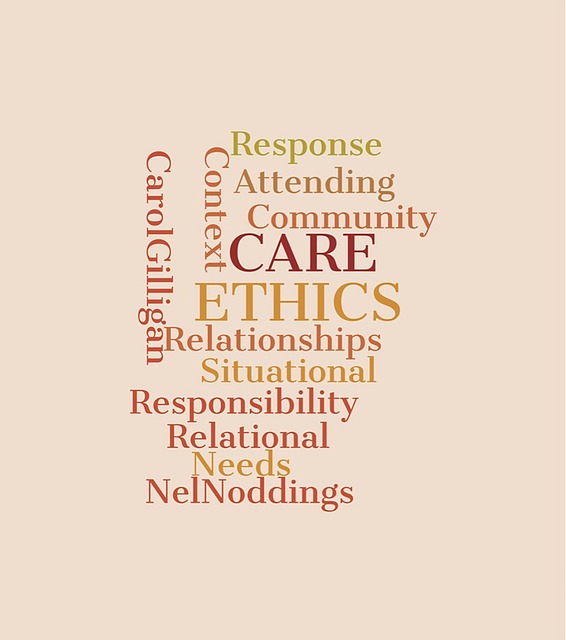
While ethics covers the big ideas of right and wrong, etiquette can be defined as the formal rules of correct or polite behaviour in society or among members of a particular profession. These are the "social manners" that help daily life run smoothly. There are certain rules for being polite when greeting each other, such as younger people greeting older people first or men greeting women first. There are also special conventions for how to behave in certain places. For example, in many cultures, women cover their heads or shoulders when entering a church, while men take off their hats. In professional settings, women might wear knee-length skirts for business and diplomacy to show respect for the formal nature of the work. The main idea behind all rules of behaviour is to be respectful and considerate of others.
Being a respectful member of society means knowing how to act in specific public places. A good example is theatre etiquette. To show respect to the actors and other audience members, one should avoid being late and turn up a couple of minutes early. If you arrive late, you must wait patiently until there is a break in the performance before going to your seat. It is essential to turn off cell phones and other electronic devices to prevent distractions. Talking, whispering, drinking, or eating during a performance is considered very impolite. Furthermore, the restroom should be used during the intermission rather than during the act. Finally, during the curtain call, one should stay to show appreciation rather than rushing for the exits. These rules ensure that everyone can enjoy the art without interruption.
Manners are taught to children as soon as they are old enough to understand language. However, learning to be polite is a long process that requires coaching and reminders throughout childhood. When a child does something right, it is important to let them know through positive reinforcement. If a child does something wrong, it is better to gently tell them how to do it better and explain why the rule exists, rather than being negative. Some basic manners for young people include waiting their turn and not interrupting others when they are speaking. They are also taught to always greet someone when they visit the house and to say please and thank you often to show respect. Other basic habits include cleaning up after oneself, not talking with a full mouth, and avoiding rude comments about food that is served to them.
At the dining table, one must behave according to social principles to show respect to the host and other guests. You should not start eating before everyone else has been served, and it is polite to stay at the table until the meal is finished. In many countries, including England and Slovakia, table manners are quite similar. It is considered rude to eat and drink noisily, to wipe the plate with bread, to pick at food with your hands, or to read at the table. Resting your elbows on the table or reaching across others is also seen as impolite. If you need something, the correct behaviour is to ask another person to pass it to you. If you wish to smoke, you must ask for permission, though in modern society, smoking is usually restricted to balconies or designated rooms.
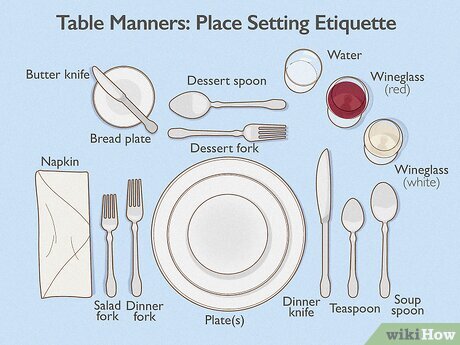
In formal settings, the placement of cutlery is very specific and follows the order in which it will be
used. The fork is placed on the left side of the plate with the points facing up. On the right side, the
knife and spoon are placed. The knife is closest to the plate with the blade facing inward. The dessert
spoon and fork are usually placed at the top of the place setting. The glass should be on the right, and
any fruit bowls or side plates are usually on the left. When you finish eating, you should lay your knife
and fork side by side in the middle of your plate. This is a non-verbal signal that the plate can be removed.
If you leave them apart, it shows that you have not yet finished eating.
Public behaviour often changes depending on the culture. For example, whenever a gentleman accompanies a lady along the street, he traditionally walks between her and the traffic to keep her safe. While people in some countries do not shake hands often, in Slovakia, shaking hands is a very common and important way to greet people, especially among men. Kissing on both cheeks is also a common form of greeting among people who know each other well. In public spaces like bus stops, people are expected to wait in a quiet and disciplined manner. In Slovakia, jumping the queue (cutting in line) is considered very rude and will lead to people angrily telling you to wait your turn.
When visiting Slovakia, it is helpful to know that people are very friendly and generous. If you are invited to a home for the first time, it is polite to bring a small present, such as a box of chocolates or flowers for the hostess, or a bottle of wine for the host. In England, invitations are often made by phone, and punctuality is very important. Being even a few minutes late can be seen as disrespectful. Furthermore, it is generally considered impolite to ask people personal questions about their salary or how much they paid for their possessions unless you are very close friends.
Finally, society has a right and a duty to enforce the law to protect its members. If anyone breaks the law and becomes a danger to others, they can be imprisoned. Most people support the idea that the punishment should fit the crime. This means that serious crimes, such as robbery, kidnapping, or murder, result in very severe punishments, while lesser crimes like shoplifting result in lighter sentences. During a trial, lawyers and judges work to find the truth by questioning witnesses who have taken an oath to be honest. By following the law and respecting the social rules of etiquette and ethics, we ensure that society remains a safe and pleasant place for everyone to live.

Obrázky použité na tejto stránke sú čerpané zo stránky:
pixabay.com
WikiHow.com